
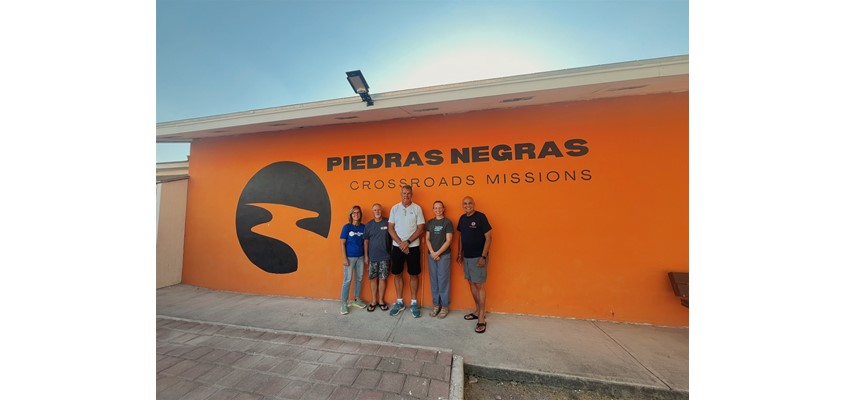
A month ago, I was asked to give a devotional for my local PWOC. This is a place for Protestant women affiliated with the Army to fellowship, worship, and study God’s word. I was happy to share about my opportunity, made possible by Southeast Christian Church, to work with CrossRoads Mexico. CrossRoads Missions is headquartered in Louisville and partners with local churches and faith-based organizations to serve distressed communities that have been affected by disasters like floods, severe storms, or poverty. Primarily, support is for construction projects that rebuild homes, repair damage, renew hope, and restore faith in God’s grace and mercy. Additionally, volunteers aspire to form relationships in these communities by “embodying Jesus’ hope, healing, and transformative love;” both physically and spiritually. This is a slightly edited version of that talk.
During the week, our group of 5 churches from across the US, stayed in the neighborhood of Piedra Angular (corner stone). This private neighborhood has a park area, a small community building with dorms, a kitchen building/fellowship patio, storage spaces, and individual homes built by the CrossRoads teams for mission staff and local Christian families living in the border city of Piedras Negras (right across the Rio Bravo/Rio Grande from Eagle Pass, TX). After a warm welcome by the staff and families, we co-signed up for various projects ranging from the construction of a 2nd intern house, providing weekly supplies for immigrants in temporary shelters, meals and prayer for family caretakers at the local hospital, or a pinewood derby competition for local schoolchildren.
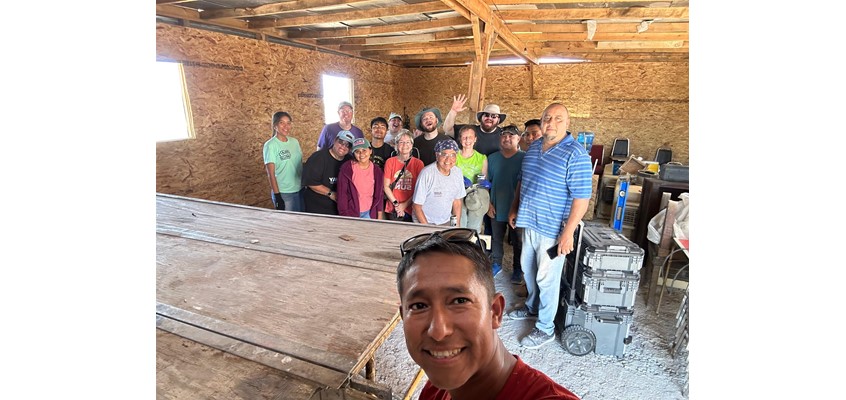
Our first morning kicked off at the church service, followed by a special baby shower and our first derby event. Dinner was nachos, the dish originated in Piedras Negras, shared among the participants and residents of the neighborhood. Along with occasional food prep, I was mostly involved in a construction project out in the city covering walls, clearing trash and weeds, and mixing cement for a temporary building on a plot land recently purchased by a newly formed church. In the evenings, after bible study and dinner, there was plenty of time to socialize with locals and volunteers or participate with lessons at The English House. I enjoyed helping the 5-8 yr olds learn simple words through playing games, as well as working with more advanced adult students practicing sentence structure, complex grammar, and idioms that we native speakers take for granted until faced with explaining the rules that govern them.
This was my first mission trip and I was scared of the uncertainty of what to expect. I thought missions were for people having very particular skills & training. Long term assignments to places with dirt floors and outdoor toilets. Dangerous places where people risk death from disease or violence. But in this case, the accommodations were comfortable, the people were kind, and the city itself is consistently amongst the top 5 safest cities in Mexico. I learned a lot about culture and history and met many great people. But my biggest lesson learned being on mission is that we are always on mission wherever we are in everyday life.
Communication between people that have a limited understanding of each other’s language and history tends to make us very careful and deliberate about what we say and how we behave. The nuances of culture and the context of words in conjunction with our actions can convey different meanings. But when we are in familiar surroundings, we can revert to autopilot, forgetting that these variations in understanding may (and often do) still exist, despite the many similarities we presume. I often give strangers more compassion and gentleness than my most cherished loved ones.
Our words influence and impact people. And our thoughts influence and impact the words we choose. In turn, experiences and words will also affect our thought patterns, making it doubly important to guard our minds and mouths to stop negative feedback loops. That’s why God’s Word tells us it is imperative to be disciplined and intentional in our thoughts; I believe thoughts are spiritual. How many scriptures, sermons, and books have stated this truth? I’m not saying anything new or revolutionary. So why do we need constant reminders? It’s simple, but it’s hard. It’s not like subconscious grammar rules automatically applied to words that put them in the correct form in our conversations. It’s more like the sentence diagram exercises we hated in elementary school. Try explaining language arts homework to a student. Simple, but it takes a conscious effort.
The Bible is God’s word, the world adds & changes its words daily, and as children we are taught how to use words and what they mean. They can be gentle, encouraging, unkind, or threatening. Sometimes the same words that push us forward, might also stop us dead in our tracks. While listening to the radio, I once heard a snippet of a sermon that stipulated prayers must be spoken aloud because prayers in your head are only thoughts, implying they don’t count until spoken. That concerned me because the majority of my prayers are silent. I might spend hours in conversation - thanking, repenting, repeating scriptures and claiming promises for provision, healing, or protection, and never utter a single sound. So I made an extra effort to speak my prayers. But it didn’t feel natural and I’d get distracted. Eventually I fell back into silent conversation. I read more and thought over things. I heard the same snippet a couple weeks ago and I decided that I didn’t agree. Words are definitely powerful when spoken, heard, written, and read. They will influence and impact positively or negatively, regardless of intent. Words are given meaning through the filter of our thoughts. That’s why I believe thoughts are spiritual. A friend loaned me a book by Caroline Leaf, titled Switch On Your Brain. She is a neuroscientist dedicated to showing how science continually provides evidence for the truth of the Bible. It’s pretty technical in the explanation of brain structures and mechanics. But, similar to the Bible, lays out a simple way to rewire the brain to eliminate negative thought patterns that stand in opposition to our identity in Christ. She calls it the 21 day Brain Detox: there are 5 parts; gather, focused reflection, write, revisit, & active reach. I find a specific verse that contradicts a negative thought or confirms a positive thought and I copy it down into my journal. Then I meditate on it, spending 7-10 minutes dismantling what I don’t want to think and building what I do want to think. Periodically review past entries and take action to reinforce it. Rinse and repeat for 3 week intervals as many times as needed. So far so good. I’m planning to do more mission trips, currently coordinating an extended trip back to Mexico, helping out devastated communities close to home, and focusing on my thoughts so my words and actions “embody Jesus’ hope, healing, and transformative love.”
During the week, our group of 5 churches from across the US, stayed in the neighborhood of Piedra Angular (corner stone). This private neighborhood has a park area, a small community building with dorms, a kitchen building/fellowship patio, storage spaces, and individual homes built by the CrossRoads teams for mission staff and local Christian families living in the border city of Piedras Negras (right across the Rio Bravo/Rio Grande from Eagle Pass, TX). After a warm welcome by the staff and families, we co-signed up for various projects ranging from the construction of a 2nd intern house, providing weekly supplies for immigrants in temporary shelters, meals and prayer for family caretakers at the local hospital, or a pinewood derby competition for local schoolchildren.
Our first morning kicked off at the church service, followed by a special baby shower and our first derby event. Dinner was nachos, the dish originated in Piedras Negras, shared among the participants and residents of the neighborhood. Along with occasional food prep, I was mostly involved in a construction project out in the city covering walls, clearing trash and weeds, and mixing cement for a temporary building on a plot land recently purchased by a newly formed church. In the evenings, after bible study and dinner, there was plenty of time to socialize with locals and volunteers or participate with lessons at The English House. I enjoyed helping the 5-8 yr olds learn simple words through playing games, as well as working with more advanced adult students practicing sentence structure, complex grammar, and idioms that we native speakers take for granted until faced with explaining the rules that govern them.
This was my first mission trip and I was scared of the uncertainty of what to expect. I thought missions were for people having very particular skills & training. Long term assignments to places with dirt floors and outdoor toilets. Dangerous places where people risk death from disease or violence. But in this case, the accommodations were comfortable, the people were kind, and the city itself is consistently amongst the top 5 safest cities in Mexico. I learned a lot about culture and history and met many great people. But my biggest lesson learned being on mission is that we are always on mission wherever we are in everyday life.
Communication between people that have a limited understanding of each other’s language and history tends to make us very careful and deliberate about what we say and how we behave. The nuances of culture and the context of words in conjunction with our actions can convey different meanings. But when we are in familiar surroundings, we can revert to autopilot, forgetting that these variations in understanding may (and often do) still exist, despite the many similarities we presume. I often give strangers more compassion and gentleness than my most cherished loved ones.
Our words influence and impact people. And our thoughts influence and impact the words we choose. In turn, experiences and words will also affect our thought patterns, making it doubly important to guard our minds and mouths to stop negative feedback loops. That’s why God’s Word tells us it is imperative to be disciplined and intentional in our thoughts; I believe thoughts are spiritual. How many scriptures, sermons, and books have stated this truth? I’m not saying anything new or revolutionary. So why do we need constant reminders? It’s simple, but it’s hard. It’s not like subconscious grammar rules automatically applied to words that put them in the correct form in our conversations. It’s more like the sentence diagram exercises we hated in elementary school. Try explaining language arts homework to a student. Simple, but it takes a conscious effort.
The Bible is God’s word, the world adds & changes its words daily, and as children we are taught how to use words and what they mean. They can be gentle, encouraging, unkind, or threatening. Sometimes the same words that push us forward, might also stop us dead in our tracks. While listening to the radio, I once heard a snippet of a sermon that stipulated prayers must be spoken aloud because prayers in your head are only thoughts, implying they don’t count until spoken. That concerned me because the majority of my prayers are silent. I might spend hours in conversation - thanking, repenting, repeating scriptures and claiming promises for provision, healing, or protection, and never utter a single sound. So I made an extra effort to speak my prayers. But it didn’t feel natural and I’d get distracted. Eventually I fell back into silent conversation. I read more and thought over things. I heard the same snippet a couple weeks ago and I decided that I didn’t agree. Words are definitely powerful when spoken, heard, written, and read. They will influence and impact positively or negatively, regardless of intent. Words are given meaning through the filter of our thoughts. That’s why I believe thoughts are spiritual. A friend loaned me a book by Caroline Leaf, titled Switch On Your Brain. She is a neuroscientist dedicated to showing how science continually provides evidence for the truth of the Bible. It’s pretty technical in the explanation of brain structures and mechanics. But, similar to the Bible, lays out a simple way to rewire the brain to eliminate negative thought patterns that stand in opposition to our identity in Christ. She calls it the 21 day Brain Detox: there are 5 parts; gather, focused reflection, write, revisit, & active reach. I find a specific verse that contradicts a negative thought or confirms a positive thought and I copy it down into my journal. Then I meditate on it, spending 7-10 minutes dismantling what I don’t want to think and building what I do want to think. Periodically review past entries and take action to reinforce it. Rinse and repeat for 3 week intervals as many times as needed. So far so good. I’m planning to do more mission trips, currently coordinating an extended trip back to Mexico, helping out devastated communities close to home, and focusing on my thoughts so my words and actions “embody Jesus’ hope, healing, and transformative love.”
